Every year in Italy there is a competition between towns and villages to decide which one is the Borgo Più Bello d’Italia
(The Most Beautiful Village in Italy). Promoted by a popular television
travel programme where the general public vote their preference, 20
villages from Valle D’Aosta down to Sicily compete to win the coveted
award.
This year 134,000 people voted the town of Gangi, in the Madonie
Mountains, as the winner. Artistic qualities, culture, local handicraft,
traditions and good food were all taken into account.
Gangi has a population of less than 8,000 and a history of mass
emigration at the beginning of the 20th century towards North and South
America as well as Northern Europe.
Built atop Monte Marone there has been a settlement since 1200 BC
when the Minoans from Crete in Greece established themselves
here. Resembling the shape of a tortoise shell, one of Gangi’s landmarks
is the XIVth century Castle of Ventimiglia, still partly owned by a
descendant of this one time powerful family.
Other noble builidngs are: Palazzo Bongiorno with its frescoed
ceilings by Roman painter, Gaspare Fumagalli; Palazzo Sgadari, seat of
the town’s museum and art gallery, and the Chiesa Madre with its famous
Judgement Day painting by Giuseppe Salerno, one of the Zoppi di Gangi
painters. Zoppo means lame in English but it is thought that the term referred to the fact that the painters were itinerant.
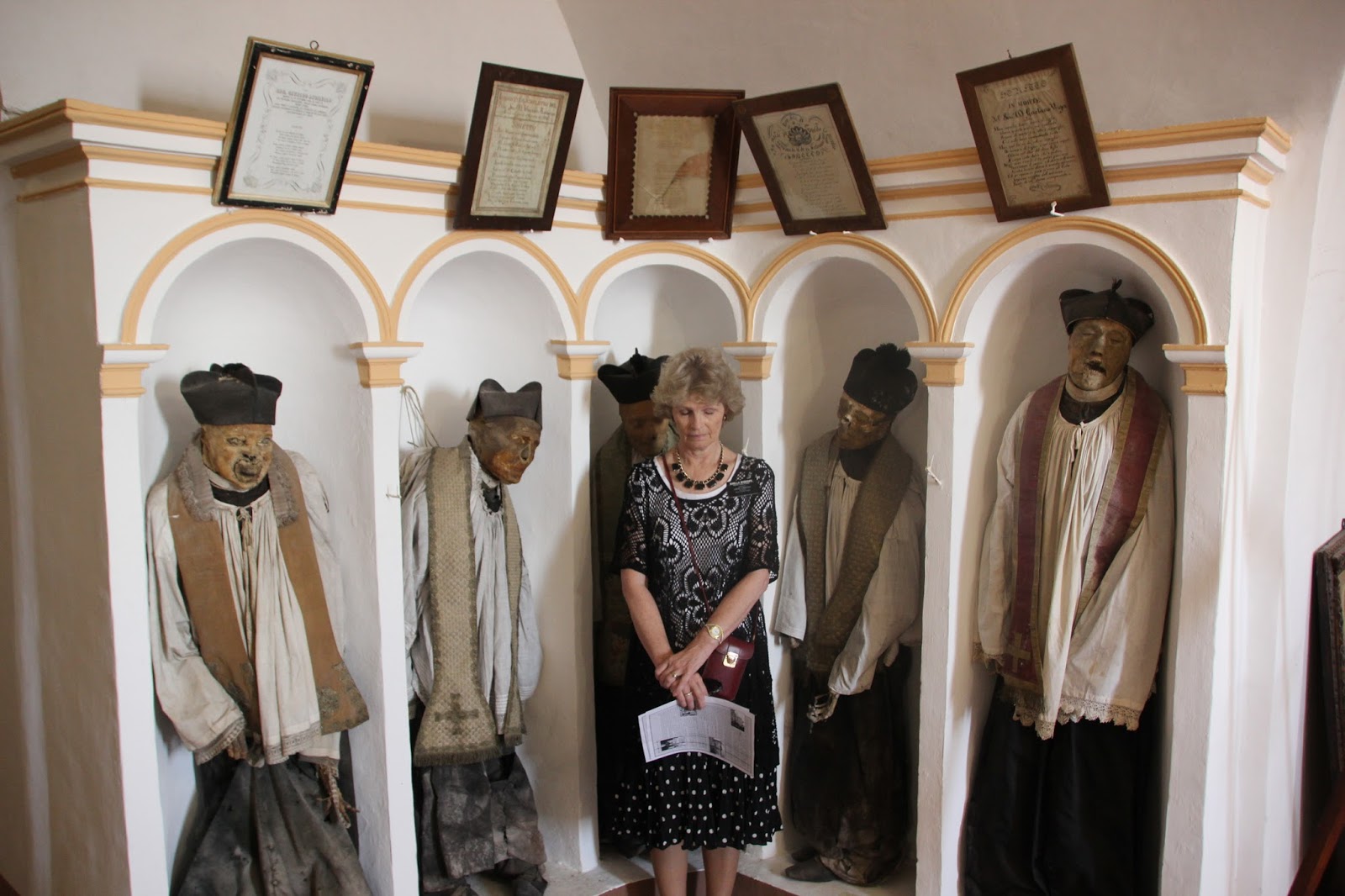
In the church of San Nicolò, down in the crypt, there are even 100 mummified priests from the 1700s.
Local cheese making – caciocavallo – and bakery and biscuit
cottage industries together with some of the most suggestive local
festivals in Sicily, all helped win this award. The patron saint San
Cataldo is celebrated on May 10th and the most characteristic, Sagra della Spiga
(Harvest Festival), takes place over a week in August where farmers
celebrate the fruits of the land. Amazing bread sculptures are hauled
through the streets by oxen pulled carts.
As with every self respecting village Gangi has its own colourful
character in the form of ‘The Queen of Gangi’. So called by a British
journalist of The Times, the name stuck. Peppina Salvo was the first
female Sicilian bandit who became the local boss controlling the town
after the former capomafia, her husband, died. A feisty woman who
preferred dressing like a man, she was the irrevocable judge of village
disputes and official matchmaker between young girls and members of her
mob. Outlawed for her whole life, she was the last person to surrender
during the Siege of Gangi in 1926 when Cesare Mori, il Prefetto di Ferro (The Iron Prefect) was sent by the Fascist regime to wipe out all mafia strongholds over the island.
Aside from the anecdotes and other attractions, the reason Gangi won
the award is mostly because of the people who live there. Spontaneous,
warm and welcoming towards visitors, theirs is an inborn hospitality
culture.
Because the freeway is closed partway between Catania and Palermo due
to a bridge that was damaged during heavy flooding in the spring, we
are forced to find creative back roads when we drive from one city to
the next. It was already a 3 hour drive, but now it takes us at least 5
hours. It takes a lot longer to drive, but we have seen some pretty
scenery and unique places along the way. Gangi was one of those
places.
We stayed at a little B&B we thought was
supposed to be right in the town, but found out addresses can be
deceiving. It was actually about 30 minutes outside town on the side of
a mountain and the road leading to it was terrible. The big surprise
was that it was a beautiful villa that is only used part time as a
B&B. The owner lives in the northern part of Italy, but he was in
Gangi when we got there. Instead of relaxing and getting some sleep, we
took him up on an offer to go for a Jeep ride even further up the
mountain to see an incredible find that is about to change the history
of Gangi. How can you pass something like that up?
He
took us nearly to the top of the mountain and showed us an ancient
granary that was used to store grain. If he hadn't pointed it out to
us, we never would have noticed it. On the right side of that, in the
middle of the rock mountain, was what looked like a small cave opening.
I have no idea how anyone would ever access it, but he said they have
found two chapels inside the mountain. We were sad we were unable to
see them.
Then he took us to another area where we
weren't even allowed to take pictures because the site was only
discovered two weeks ago and a group of archaeologists are will be here
in a few days to investigate the new find.